













The Evolution of U.S. Army Body Armor since WWII
This Vest May Save Your Life!
While the tactical adage 'speed is security' applies to vehicles, aircraft, and individual soldiers alike, the addition of armor presents an inherent trade-off: increased protection often comes at the expense of mobility. Since World War II, the U.S. Army has worked to engineer body armor that effectively balances these competing demands. As noted in historical field reports, the use of armor is driven by the fundamental psychological impulse for survival. In the heat of combat, soldiers frequently report being oblivious to the weight and bulk of their equipment; in these high-stress moments, the psychological need for protection appears to outweigh the physiological burden of the extra load.
A turning point occurred in 1952 during field testing of the T–52–1 body armor vest in Korea. The U.S. Army Body Armor Test Team reported that the vest successfully defeated 75.7% of all fragments and 24.4% of small-arms fire. This was a landmark achievement, considering the rudimentary state of armor technology at the war's onset in 1950.
Since the Korean era, the U.S. Army has relentlessly iterated on armor design to maximize survivability. This article traces the evolution of Army body armor from World War II to the modern era, with a specialized look at the U.S. Special Operations Command (USSOCOM) and its Special Operations Forces Personal Equipment Advanced Requirements (SPEAR) program.

“This Vest May Save Your Life!” was printed on the inside tag of Korean War-era U.S. Army body armor. The vest weighed 8 pounds, while those worn in post-9/11 conflicts in weighed up to 33 pounds.
World War II
During World War II, the U.S. Eighth Air Force, under the leadership of Command Surgeon Colonel Malcolm C. Grow, pioneered the development of modern body armor. By 1943, 'Mighty Eighth' aircrews began receiving armored vests manufactured in Great Britain. These early models featured two-inch square manganese steel plates sewn into a canvas carrier, designed specifically to deflect antiaircraft shrapnel—widely known as 'flak.' Following successful field trials, the design was standardized and production moved to the United States. Officially designated the Flyer’s Vest, M1, it became colloquially known as the 'flak suit.'
At 17 pounds and 6 ounces, the M1 was manageable for seated personnel like pilots, who often sat directly on the vests to protect against fire from below. However, the weight proved cumbersome for waist gunners who had to remain mobile. This led to the development of specialized armor tailored to specific crew roles: the M3 Apron for ball-turret gunners, the M4 for waist gunners, and the M5 Groin Armor for seated crew. By the war’s end, production exceeded 300,000 M1 vests and nearly 100,000 of the improved M2 variant.
A 1944 Eighth Air Force study underscored the armor's success, revealing that it slashed fatalities from thoracic wounds from 36% to 8%, and abdominal wounds from 39% to 7%. Despite this data, the Army initially deemed such armor impractical for ground troops due to its weight and restricted mobility. It wasn't until the end of the war that the Ordnance Corps developed the 12-pound M-12 vest, utilizing aluminum plates and nylon, though it never saw combat testing.
In 1947, development responsibility shifted to the Quartermaster Corps, which initially prioritized mine-clearance suits for engineers. A 1949 study reaffirmed the belief that armor for active infantry remained too heavy for frontline use. Consequently, when the Korean War erupted in 1950, the WWII-era M-12 was deployed as a stopgap measure until modern alternatives could be engineered.

M1 Flyer’s Vest - Developed during World War II to protect U.S. Army Air Forces bomber crews from antiaircraft shell fragments, the M1 Flyer’s Vest is shown here paired with the Flyer’s Apron, M3. Together, the vest and apron weighed approximately 22 pounds.
 “A miss—almost,” recalled this B-17 Flying Fortress waist gunner, shown here with his damaged M1 Flyer’s Vest (left) and parachute pad (right).

T64/M12 Vest - The T64 vest was chosen for series production as the M12 in the summer of 1945 with 100,000 supposed to be finished by the end of August. The M12 body armor vest utilized aluminum plates encased in nylon and weighed 12 pounds, 3 ounces. The example shown here includes the optional T65 apron. The M12 vest remained in use during the Korean War until newer models could be deployed.
Korean and Vietnam Wars
Two successful body armor designs emerged during the Korean War. The first was the M-1951, a joint Army-Marine Corps development featuring nylon and 'Doron'—a laminated fiberglass material originally engineered during WWII. Weighing just under eight pounds, this 'Marine Vest' saw service across both branches. The second was the Army’s M-1952A, an 8.5-pound vest constructed from twelve layers of flexible laminated nylon. While it performed well in trials, it saw only limited front-line distribution by late 1952.
In Vietnam, the M-1952 remained a staple alongside the M-1955, the successor to the M-1951. These were eventually phased out by the M-69 Fragmentation Protective Vest. Weighing 8.4 pounds, the M-69 mirrored the M-1952’s construction but added a distinctive ¾-inch protective collar. Though an improvement, the collar was frequently criticized for interfering with the M1 helmet. In the stifling tropical climate, patrolling soldiers often abandoned the bulky, heat-trapping vests, leaving them to troops in static defensive positions or unarmored convoys.
While ground armor struggled with climate-related adoption, aviation armor saw specialized progress. Initially, early helicopter crews lacked armor due to strict payload constraints. However, the increased ground fire faced by more powerful transport helicopters in Vietnam necessitated a change. After early, poorly received 18.5-pound models, the Army introduced ceramic plates in 1964 to stop .30-caliber armor-piercing rounds. By 1966, an improved—though 28.5-pound—system was fielded. To combat the tendency of these plates to splinter upon impact, crews often layered standard flak vests over the ceramic to contain secondary fragmentation. By the early 1970s, testing concluded that a new, integrated system was far more satisfactory than this improvised layering.

M-1952A flak vest - The M-1952 body armor vest was constructed entirely of nylon and weighed 8.5 pounds. The improved M-1952A variant began to reach U.S. Army troops in Korea by late 1952 and remained in service through the Vietnam War.

M-69 Body Armor - Fielded during the Vietnam War, the Body Armor, Fragmentation Protective with ¾ Collar—more commonly known as the M-69—closely resembled the earlier M-1952 it replaced. Its defining feature was a stiff collar that added neck protection, though it could sometimes interfere with wearing the M1 steel helmet.
U.S. Army Combat Capabilities Development Command Soldier Center
Since 1954, the U.S. Army Natick Soldier Systems Center (NSSC) in Massachusetts has served as the epicenter for body armor research and development. Now designated the Combat Capabilities Development Command (CCDC) Soldier Center, this institution has undergone several name changes while maintaining a singular focus: optimizing soldier performance, combat readiness, and lethality. Operating under the Army Futures Command, the CCDC’s Soldier Protection and Survivability Directorate remains dedicated to a dual mission—reducing the soldier's physical load while ensuring that modern warfighters remain protected, optimized, and lethal on the battlefield.
Post-Vietnam to 9/11
Throughout the Vietnam War, ground forces remained equipped with body armor designs dating back to the Korean conflict. The Army relied primarily on laminated nylon for ballistic protection, as it was considered superior to steel for defeating fragmentation. Despite a marked increase in small-arms injuries in theater, a 'variable-type' armor—which integrated soft fragmentation protection with hard ballistic plates—did not reach frontline troops until 1969, and then only in negligible quantities.
In the post-Vietnam era, the Army overhauled its armor programs by leveraging a revolutionary lightweight material: Kevlar. This culminated in the 1983 fielding of the Personnel Armor System for Ground Troops (PASGT), a camouflaged 'soft' armor vest. Although the PASGT was slightly heavier than the M-69 at nine pounds, it offered significantly improved fragmentation protection, greater flexibility, and superior ergonomics. This system became the standard for U.S. forces in subsequent conflicts, including Grenada (Operation Urgent Fury), Panama (Operation Just Cause), and the Persian Gulf (Operations Desert Shield/Desert Storm).

PASGT Vest - The PASGT (Body Armor, Fragmentation Protective Vest, Ground Troops) provided improved protection over the earlier ballistic nylon vests used in Korea and Vietnam—such as the M-1952 and M-69—through its use of Kevlar inserts, without substantially increasing weight.
To address the unique operational requirements of the 75th Ranger Regiment, the U.S. Army Natick Soldier Center developed the Ranger Body Armor (RBA) in the early 1990s. While the RBA utilized the flexible Kevlar inserts of the PASGT system, it introduced a critical innovation: an eight-pound aluminum oxide ceramic plate designed to shield the torso from 7.62mm ball ammunition. During the Battle of Mogadishu in October 1993, the RBA proved its effectiveness by saving lives and significantly mitigating the severity of gunshot wounds. Subsequent upgrades added a rear ballistic plate, bringing the system's total weight to 25.1 pounds.

Ranger Body Armor (RBA) - The Ranger Body Armor (RBA) was the first Army vest to integrate a ceramic plate for “hard” smallarms protection with “soft” Kevlar fragmentation protection. This design influenced later systems such as the Interceptor Body Armor and signaled a shift away from fragmentationonly “flak jackets.” Although initially issued with only a front plate, the vest shown here was configured to accommodate both front and back plates.

U.S. Army Rangers tested their new Ranger Body Armor (RBA) during the Battle of Mogadishu in October 1993.
The combat effectiveness of hard armor plates was definitively confirmed during operations in Somalia. Consequently, in 1996, the Army fielded the Interim Small Arms Protective Overvest (ISAPO)—a plate carrier equipped with front and rear boron carbide ceramic plates capable of defeating 7.62mm rounds. When worn over the standard PASGT vest, the system added 12 to 16 pounds, resulting in a total load of 21 to 25 pounds. As indicated by its 'interim' designation, fewer than 4,000 units were issued. Nevertheless, both the RBA and ISAPO signaled a pivotal shift from fragmentation-only 'flak jackets' toward integrated systems providing small-arms protection—albeit at the expense of increased weight during high-intensity maneuvers.

ISAPO (Interim Small Arms Protective Overvest) - The Interim Small Arms Protective Overvest (ISAPO) was equipped with front and back ceramic plates and weighed 16 pounds. When worn over the PASGT vest, the combined system weighed approximately 25 pounds.

PASGT-ISAPO combination
This transition was solidified in June 1999 with the introduction of the Interceptor Body Armor (IBA). Its core component, the Outer Tactical Vest (OTV), utilized advanced Kevlar inserts capable of defeating fragmentation and 9mm handgun rounds. When reinforced with two boron carbide Small Arms Protective Inserts (SAPI), the system could withstand multiple strikes from 7.62mm ball ammunition. At 8.4 pounds, the OTV was lighter than the earlier PASGT; even with both SAPI plates installed, the total weight was only 16.4 pounds—a significant nine-pound reduction compared to the awkward PASGT-ISAPO combination. Furthermore, the OTV featured full compatibility with Modular Lightweight Load-carrying Equipment (MOLLE), enabling soldiers to tailor their loadouts with holsters, pouches, and medical kits. Despite these advancements, relatively few IBA units had been fielded by the time of the September 11, 2001, terrorist attacks.

Outer Tactical Vest (OTV)

The Interceptor Body Armor (IBA) system originally comprised two core elements: the Outer Tactical Vest (OTV) for fragmentation protection, shown here, and front and back Small Arms Protective Insert (SAPI) plates. Additional removable panels for the neck, throat, and groin were available, though their use added weight and reduced comfort. In response to evolving threats, Deltoid and Axillary Protectors (DAPs) and Enhanced Side Ballistic Inserts (ESBIs) were later introduced, bringing the total system weight to over thirty pounds.

This photo of an Information Operations (IO) “Tiger Team” operating in Mosul, Iraq, in April 2003 shows the variety of body armor worn early in Operation IRAQI FREEDOM. In the front row, the soldiers at each end are wearing Ranger Body Armor (RBA), while the other three have Interceptor Body Armor (IBA). In the back row, the soldier on the far right is equipped with the Personnel Armor System for Ground Troops (PASGT) vest, and the captain in the center wears the Body Armor Load Carrying System (BALCS).
Post 9/11
During Operations Enduring Freedom (OEF) and Iraqi Freedom (OIF), soldiers initially deployed with a fragmented inventory of protection, ranging from the new Interceptor Body Armor (IBA) to legacy Ranger (RBA) and PASGT vests. The massive scale of OIF exposed a significant logistical bottleneck: due to the high cost of SAPI plates ($712 per set), the Army initially issued only one set of plates for every three Outer Tactical Vests (OTV) fielded. While U.S. Army Special Forces (USASFC) received an exception for full issuance, other units faced shortages until a 2003 USCENTCOM directive mandated a complete 'suit' of armor—OTV plus plates—for all personnel in theater. By 2006, the Army had successfully distributed nearly 900,000 SAPI sets.
Casualty analysis from the front lines drove rapid, incremental upgrades to the IBA. In 2004, Deltoid and Axillary Protectors (DAPs) were introduced to shield the upper arms, followed in 2006 by Enhanced Side Ballistic Inserts (ESBIs) to protect the torso's flanks. Simultaneously, Enhanced SAPI (ESAPI) plates—capable of stopping .30-caliber armor-piercing rounds—replaced the original SAPI plates. However, these life-saving additions came at a physical cost: a fully configured IBA now weighed 33 pounds, excluding the significant weight of ammunition, radios, and medical gear.
To address mounting weight and comfort concerns, PEO Soldier fielded the Improved Outer Tactical Vest (IOTV) in 2007. While maintaining a protection level comparable to the IBA, the IOTV introduced a vital quick-release mechanism. This allowed soldiers to instantly shed the vest during vehicle rollovers, fires, or water submersions, and provided medics with faster access to wounds. Despite being marketed as a lighter solution, a combat-ready IOTV still tipped the scales at approximately 32 pounds.

Improved Outer Tactical Vest (IOTV) - First introduced in 2007 and shown here with Deltoid and Axillary Protectors (DAPs), the Improved Outer Tactical Vest (IOTV) offered protection comparable to the IBA it replaced. Its key advancement was an integrated quickrelease system, allowing the vest to be rapidly removed in emergencies.
Mounting concerns from constituents and military families prompted Congress to investigate whether the Department of Defense was lagging in the development of lightweight protection. During a 2011 hearing, Brigadier General Peter N. Fuller—then head of PEO Soldier—admitted to a House Armed Services subcommittee that armor development had 'hit a technical wall' regarding weight. He emphasized the necessity of a strategic trade-off: sacrificing some ballistic coverage to 'provide Soldiers with relief from the weight of body armor.'
These findings were echoed in a 2012 RAND Corporation study, 'Lightening Body Armor.' While the report confirmed the armor’s effectiveness—noting zero fatalities from threats the gear was rated to stop—it concluded there was no 'silver bullet' for immediate weight reduction.
In response, PEO Soldier fielded the Soldier Plate Carrier System (SPCS) in 2010 as a streamlined alternative to the bulky IOTV. At 22 pounds with full plates—10 pounds lighter than a combat-ready IOTV—the SPCS traded peripheral soft-armor protection for significantly enhanced mobility. It was deployed primarily to units in Afghanistan, where the high altitudes and punishing terrain made weight a decisive factor. While both systems remain in the inventory, the Army is currently transitioning toward its most advanced design yet: the Modular Scalable Vest (MSV).

Multicam KDH SPCS Plate Carrier W/3a Armor Inserts Front,back & Cummerbund - In 2009 the U.S. Army began testing various commercial, off-the-shelf plate carriers for issuing to troops deploying to Afghanistan as a lighter and more comfortable alternative to the IOTV. The KDH Defense Systems Magnum TAC-1 plate carrier was chosen over other competitors. An initial contract worth $18.6 million was signed with KDH for 57,000 plate carriers.
As a core component of the broader Soldier Protection System (SPS), the Modular Scalable Vest (MSV) weighs approximately 25 pounds—engineered to provide superior range of motion, enhanced ventilation, and a more ergonomic fit than the IOTV. The SPS is a comprehensive suite that includes a ballistic combat shirt, a blast pelvic protector, integrated head protection, and transitional eyewear. While several of these components have already reached the field, the full system was slated for operational testing in fiscal year 2019. The degree to which the finalized SPS configuration will successfully alleviate the soldier’s physical burden remains a subject of ongoing evaluation.
Special Operations Body Armor
The U.S. Army Special Operations Command (USASOC) drives innovation in ballistic protection for its forces through the SPEAR program—a USSOCOM-funded initiative dedicated to Special Operations Forces Personal Equipment Advanced Requirements. Since 1996, the development of modular body armor and load-bearing equipment has been a core pillar of the SPEAR mission. This effort culminated in 1999 with the introduction of the Body Armor and Load Carrying System (BALCS), a landmark modular platform that redefined personal protection for the modern operator.

BALCS - The Body Armor Load Carrying System (BALCS), an early USSOCOM body armor design, was used by Special Forces soldiers during the initial stages of Operations ENDURING FREEDOM and IRAQI FREEDOM.
Within USASOC, the BALCS was primarily issued to 75th Ranger Regiment and Special Forces personnel. Tactical PSYOP, Civil Affairs, and other ARSOF support elements received SPEAR-tier armor as production allowed, utilizing standard-issue systems—such as the IBA, IOTV, and SPCS—as interim substitutes. The SPEAR program also extended specialized protection to ARSOF aviators through its dedicated Aircrew initiative. Subsequent SPEAR evolutions introduced more advanced load-carriage platforms, most notably the Releasable Body Armor Vest (RBAV) and the Modular Body Armor Vest (MBAV).

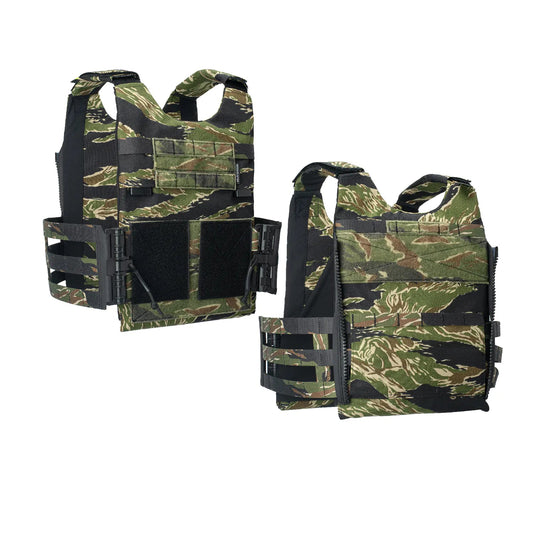
RBAV - A Releasable Body Armor Vest is a tactical plate carrier or armored vest designed with a specific mechanism that allows the wearer to completely and rapidly doff (take off) the entire system with a single pull of a cord or handle.

MBAV - Modular Body Armor Vest (MBAV) is a category of protective gear designed for tactical use that features a scalable and interchangeable design. The term "modular" primarily refers to its ability to be customized and adjusted for a wide range of mission profiles, threat levels, and individual comfort needs.
Through the SPEAR program, USSOCOM has profoundly influenced broader Army body armor development—a trend clearly reflected in the evolution of the SPCS and the Modular Scalable Vest (MSV). SPEAR also played a pivotal role in the engineering of the Army’s Enhanced Small Arms Protective Insert (ESAPI) plates. This trajectory of cross-service innovation reached a new milestone in 2014 with the fielding of the Adaptive Vest System (AVS).
As a key component of the Family of Tactical Ballistic Armor (FTBA), the AVS shares significant conceptual and architectural DNA with the Army’s MSV. However, it distinguishes itself by utilizing specialized, lightweight ballistic plates and Modular Supplemental Armor Protection (MSAP) as alternatives to the standard-issue ESAPI and ESBI side plates.

AVS - The Adaptive Vest System (AVS) is a highly modular and scalable tactical gear platform, primarily manufactured by Crye Precision.
Conclusion
Since the Korean War, the U.S. Army has consistently fielded body armor to enhance soldier survivability. Yet, while ballistic protection has advanced exponentially since the early M-12 vests, these gains have often come at the expense of mobility and tactical effectiveness.
Until the mid-1990s—prior to the introduction of Ranger Body Armor (RBA) and the Interim Small Arms Protective Overvest (ISAPO)—individual systems rarely exceeded ten pounds. In the decades since, armor has seldom weighed less than 25 pounds, as every innovation in lightweight materials has been offset by the requirement for additional protective plates.
In the absence of a 'miracle' material, 'scalability' and 'modularity' have emerged as the defining design philosophies of the last decade. Through the SPEAR program, USSOCOM pioneered the modular approach, a path the Army has followed with the multi-layered Soldier Protection System (SPS) and its Modular Scalable Vest (MSV). While scaling down coverage inherently involves accepting greater ballistic risk, modularity remains the most viable method for weight management in the foreseeable future.
As Brigadier General Peter Fuller noted in 2011, reducing coverage increases the risk of injury to unprotected areas, but the resulting mobility can lead to higher overall survivability in specific terrains. His assessment reaffirms a timeless truth of the battlefield: often, the best form of security is the ability to move faster than the enemy.


